
Saving the Desktop II
Is there a real alternative to the hegemony of American computing platforms? Yes, there is--if you make a slightly different devil's bargain

Last year I wrote a post pointing out that most of the world is dependent on American software stacks—especially the operating system—and that we who do not live in the U.S. need alternatives to guarantee the safety and integrity of our data. I think it’s fair to say that, as the ‘51st state’ talk looks less and less like rhetoric and more and more like an operational plan, withdrawing from dependence on the American stack seems more urgent.
In that original post I came down heavily on Linux, because it’s not really a desktop operating system. It’s a server OS beloved of computer programmers and systems geeks, with a graphical user interface bolted on top of it. I’ve been trying to move to Linux for more than 20 years—because it and 90% of what you’ll run on it are free—but every time I start that migration, it lets me down. I’ll have a system running, sometimes for a few months, and then I’ll do something innocent like update a software package, and the whole thing will crash irrecoverably. The reaction of Linux advocates is inevitably, “well, it’s a different paradigm, you have to learn it.” To which I reply, Hell no, I don’t have time to spend studying operating system design, I need to do my job. And my job is not system administrator.
Another common ploy has been for Linux advocates to set it up on their elderly parents’ computers and then claim that “even Grandma can use it!” Well the reason they can use it because their son or daughter is working as a free system admin. When things crash, Junior fixes it, so they can claim the system “just works.”
Online help doesn’t. It may be true that anything you need to know is available on a web page somewhere, but what you need can be very hard to find, especially when you don’t know how to describe the problem you’re having. “The screen went black” is not a great Google prompt.
Partly out of desperation and frustration, and partly because I like it, I advocated Haiku as an alternative OS. It keeps getting better; it was already more stable than any Linux distro I’ve tried as a desktop when I wrote the article. Huge amounts of free Linux software have been ported to it; it even runs LibreOffice and Blender.
Still, I couldn’t recommend it (yet) as your home office machine, because Haiku lacks some basic stuff, like secure logins, or indeed security of any kind at all. Also drivers for modern devices such as NVIDIA GPUs.
The Enshittification of Windows
Microsoft makes no money from Windows anymore, so they have no incentive to maintain it. Windows, in version 11, has been overhauled as a glorified terminal that connects you by default to an Azure backend on MS’s servers. Just try saving a Word 365 file to your Documents directory and you’ll see what I mean—it’ll do it, but to the Onedrive Documents directory, not your local machine. In many other ways, subtle or sledgehammer, Windows 11 tries to drag you and all your data into their cloud.
I’ve had it with that, so a while back I started migrating to Linux Mint. Yes, Linux, the very same OS I just trashed for being unusable by unmodified human beings. I had no choice. Haiku’s not quite ready and there are no other viable alternatives.
I expected problems with Mint, and boy, did I get them. Arbitrary crashes every hour or so, to start with. I’d be doing some ordinary on the desktop and BOOM, down everything went. Absolutely typical.
This time is different, though, because while I may not be a Linux administrator, I have one on call 24 hours a day. It’s called ChatGPT.
Gemini will work for this too, as will Deepseek, Claude, Mistral, and many other LLMs. If you want the ultimate in privacy and security, you can run an LLM locally on one computer and use it to troubleshoot another. This is exactly what I’ve been doing.
Routing Around the Problem
Linux’s shortcomings have not gone away. It is still a command-line driven server OS with a happy face GUI stickered onto it. The difference, in 2026, is that the AI companies have been optimizing their platforms to aid computer programmers and, yes, sysops. AIs such as GPT know a lot about Linux. As I discovered when troubleshooting my frequent crashes, they know enough that you can use one as a buddy to walk you through diagnosing and fixing most issues. You can also use them to help you optimize the system, install and administer tricky software that needs command-line expertise, and more.
Linux Mint is already dead easy to install and run—up until you hit that inevitable wall, which, to be fair, might not happen to you for a good long time. The thing is that when you do run into problems, it’s now easy to figure out what’s going on, and easy (if sometimes terrifying) to get them sorted.
My own migration is complete. I’m able to do all the stuff I was doing on Windows with none of the enshittification or outright theft of my data. I’m not worried about security anymore, and I don’t have to reboot every day because MS demands that I install an update. The Mint interface is glorious and the system is much faster than it was running Windows. I don’t understand Linux any more than I did when I started down this road, and I have no desire to. I just want to get my work done; and I can, using:
Koofr instead of OneDrive for online backup
LibreOffice instead of MS Office
Firefox as my browser
Thunderbird as my email app
Obsidian, natively, for note-taking
Todoist, natively, to keep me organized
Noson to run my Sonos sound system and keep the music flowing
Alpaca to locally run free AI models
Scrivener and a handful of other essential Windows apps managed by WINE and perfectly operational
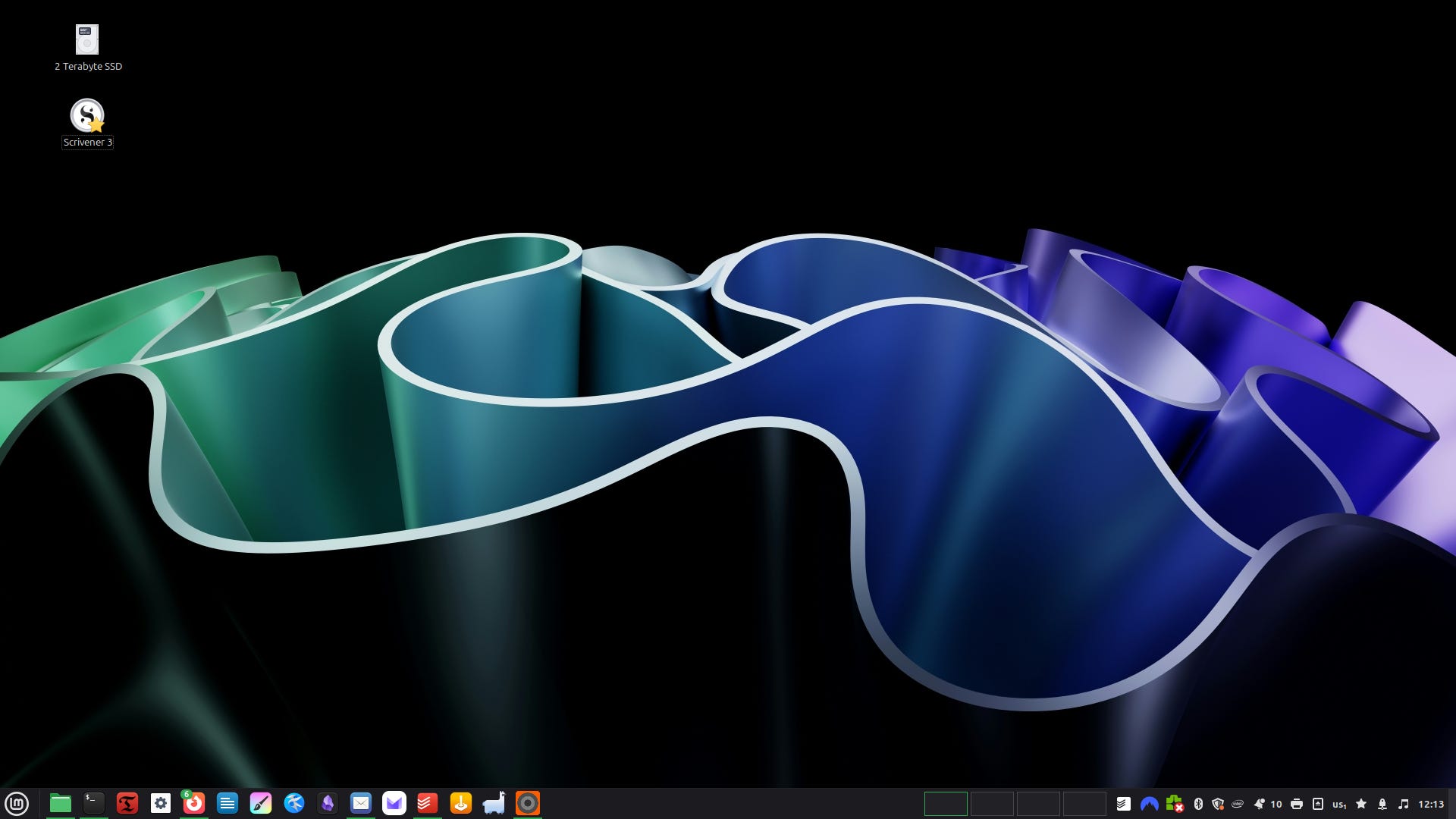
Now, when issues come up, I can lean over and ask an AI how to fix them, and then get right back to work.
Having our own admin constantly on-call might finally make Linux a viable OS for ordinary people. If you find Apple’s and MS’s systems too expensive, are worried about them being back-doored by their government, or are simply frustrated as I was with their increasing enshittification, consider sitting down with a friendly AI and trying Linux.
Just make sure it is a friendly AI. But that’s a whole other issue to worry about…
I’ll report back in a few months to tell you how my own experiment’s gone—or sooner, if it all blows up.
—K
Nice you mention Haiku 🤓 it's still niche but shows the innovative potential BeOS had back in the day it's still relevant and innovative today, more than ever. You might want to keep an eye on the progress, I'm running it as my main driver on my development machine, also for everyday tasks.
I do need to do more with my little linux laptop than play nes looking games on it.