
Quantum Politics
Can we ground our divisive political discussions in a reality that neither Left nor Right can argue away?

Is politics in the 21st century using 21st century ideas and tools? If not, what can we do? And how relevant is this to you and to this present moment? Without going into details that only a professional physicist or political scientist can understand, I’m going to try to unpack these questions and give you a glimpse of what ‘quantum politics’ might look like.
A while back I wrote a post about Quantum Literature. Now of course any article that has ‘quantum’ in the title should be looked at with extreme suspicion. (In general, run screaming.) It’s important to realize that QM is a specialist’s walled garden, and while the rest of us non-physicists can peek over the edge, we can’t really play there.
The dilemma is that if QM does have things to say about reality beyond the subatomic scale (and it seems that it does) then what goes on in that garden affects everybody. We are all stakeholders, and what happens down in that realm affect us.
Nowhere is this more true than in politics.
Politics is the art of decision-making in conditions of uncertainty. If all facts, norms, procedures, and outcomes are understood and agreed-upon by all stakeholders, then there is no politics; there is only bureaucracy. Progress in Western civilization can be seen as the struggle to transform political issues into bureaucratic procedures. This has progressed via an ever-widening circle of agreement on facts and norms. Politics occurs where there is still disagreement.
What makes the current moment so dangerous is that the far right has hijacked the (originally progressive) postmodern project and weaponized it as a tool for blowing up all circles of agreement. By contesting everything, they seek to de-legitimize the institutions that keep you safe and healthy—from constitutional law to vaccines and basic science itself. The aim is to politicize it all, that is to say, to make it uncertain. If it’s uncertain, then ‘sovereign citizens’ with enough power can act with impunity. Impunity is the goal.
The uncertainty surrounding how separate the “classical realm” of human-scale reality is from the quantum one makes the very idea of a quantum politics, well, political. There is no agreement about whether QM can be applied to politics, but the question is out there now; the recent book Quantum International Relations gives a good summary if you’re interested in the whole scope of the debate.
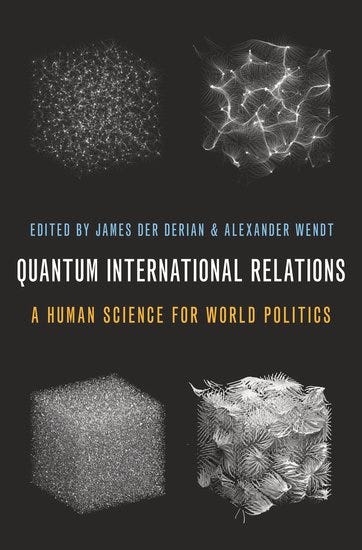
Here’s a quick summary of its main ideas; more pertinently, an excellent review of the book raises some key questions: are we supposed to use QM’s ideas as metaphors in the political realm, or as somehow reflecting reality ‘on the ground’? Is using scientific ideas this way just another appeal to authority? Do we even need it? Granted that politics is already about ambiguity and uncertainty, are we just swapping out one terminology for another?
These are all good questions; for reasons I’ve gone into before, I think there are answers to these criticisms. They’ve been explored in detail in two books I’ve boosted in previous posts: Karen Barad’s Meeting the Universe Halfway, and Arun Bala’s Complementarity Beyond Physics. I won’t try to drag you down that particular rabbit hole. Instead, I’ll state their core argument in simple terms, and then build a model political regime based on that; to hedge my best, I’m going to lean in the direction of treating QM’s concepts as metaphors for now.
Let’s go.
Allow Me to Complement You
Here’s the simple idea: we’ll use Niels Bohr’s principle of complementarity to model political systems.
In quantum physics, a single system cannot be fully captured by a single classical picture; you need both the wave and the particle description to obtain a complete account of a photon’s behavior, for example. By analogy, a polis might be said to require both conservative (stability‑oriented, tradition‑preserving) and liberal (change‑oriented, rights‑expanding) perspectives in order to capture the full range of societal dynamics.
Just as a quantum system exhibits interference patterns only when both wave and particle aspects are taken into account, a society may achieve a richer, more resilient equilibrium when policies reflect both tradition and transformation. The absence of either side can lead to pathological extremes: unchecked radical change can erode social cohesion, while rigid conservatism can ossify institutions and stifle progress. This is a central theme of Keiji Nishitani’s critique of modern Buddhism, for example: it was (in his day) ceasing to have any societal relevance because the monastics were working to preserve their own way of life without reference to the experience of the laiety, who were modernizing rapidly. This pattern repeats constantly, particularly throughout the 20th century, in many different contexts.
Mutually Exclusive Views Are Necessary
Bohr discovered that measurement forces a quantum system into one of the complementary states (wave or particle), and the choice of experimental setup determines which aspect becomes manifest. Translating this to politics suggests that institutional “measurements”—elections, referenda, judicial rulings—select which perspective dominates at a given moment.
Electoral cycles act like a measurement apparatus: a conservative‑leaning outcome foregrounds stability, while a liberal‑leaning outcome foregrounds change.
The act of measuring (voting, policy enactment) inevitably collapses the political superposition into a concrete decision, temporarily suppressing the alternative viewpoint.
The analogy highlights a tension: societies continually re‑prepare the complementary state after each measurement, because the suppressed perspective remains latent and can re‑emerge when conditions shift. This mirrors how, after a particle‑type experiment, the wave‑like interference pattern can be recovered in a subsequent setup.
This Is Cute, But…
We should recognize that we’re using complementarity as a metaphor in this case, and at some point metaphors break down:
Quantitative vs. normative domains. Quantum complementarity is a mathematically precise statement about observable operators; politics involves values, power relations, and cultural meanings that resist formal quantification.
Binary oversimplification. Bohr’s complementarity deals with two mutually exclusive bases. Political spectra are multidimensional—economic, cultural, environmental, identity‑based—and many positions do not fit neatly into a simple “conservative/liberal” dichotomy.
Agency and intentionality. Quantum systems lack agency; political actors deliberately shape institutions, rhetoric, and coalitions. The “measurement” in politics is not a passive observation but an active, strategic act.
The complementarity metaphor works best as a heuristic—a way to remind us that opposing viewpoints can be jointly indispensable—rather than a rigorous theory of governance.
Using it Anyway
For the sake of argument, let’s say we accept the complementarity framing as a heuristic. If we do, several practical implications fall out.
Uncertainty is a feature, not a bug. We don’t want to be too sure of our politics, that would defeat its purpose in a 21st century context.
Institutional design should embed mechanisms that guarantee representation of both currents (e.g., bicameral legislatures, proportional representation, independent judiciaries).
Deliberative processes ought to treat dissent not as a problem to be eliminated but as a source of “constructive interference” that can produce more robust policies.
Civic education can emphasize the idea that embracing the “other side” does not betray one’s principles; it simply acknowledges the full phenomenology of the political system.
Bring in Barad
Karen Barad’s agential realism takes Bohr’s discovery of complementarity and gives it a little nudge. If, say, an experimenter is measuring particles, they have the option of setting up an apparatus to check the particle’s momentum, or its position; but never both at the same time. Taking the experimenter+apparatus+particle as a single phenomenon, it’s clear that inside this phenomenon, a kind of orientation or “cut” is made that results in either a particle with position, or one with momentum. The agent that makes this cut doesn’t have to be a human being; the key point is that once the cut is made, the kind of outcome that is possible has changed: momenum or position, never both.
This observation pushes the principle of complementarity beyond a simple “two‑sides‑are‑both‑needed” framing. Barad argues that phenomena are intra‑active entanglements of matter, meaning, and discourse; what counts as subject or object does not pre‑exist the encounter, they are co‑constituted through agential cuts. That sounds a bit woo-woo, but all it is, is an attempt to answer the “if this, then what?” question left unanswered by traditional “shut up and calculate” approaches to QM.
Applying agential realism to the political realm reshapes the earlier complementarity picture in some major ways.
