
My Library: Full House
The idea of Progress is seductive, and so intuitive that we never question that there is a direction to it. Stephen J. Gould did and the result is astonishing

There’s an unstated assumption behind our narratives about AI. Sure, computers have come to steal our jobs, outsmart us and become our masters, or wipe us out and replace us. Lots of ink and pixels have been spilt on how and why. They all boil down to a simple equation: smarter = better.
But what if that isn’t true?
This is the question Stephen Jay Gould sets out to answer in his 1996 book, Full House: The Spread of Excellence from Plato to Darwin. He asks why organisms on Earth have gotten more complex over time, and ultimately, why one in particular—humanity—has taken over to such an extent that more than 90% of all land animals alive today are our livestock or our pets. His answer is shockingly simple and incidentally upsets the whole applecart of the “AI will be more successful than we are” argument. That’s why it’s in my library of essential reading.
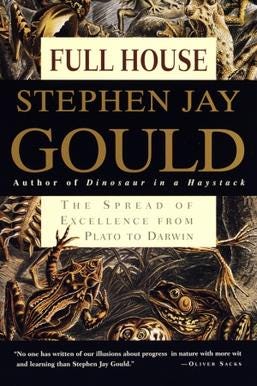
Gould is best known for his 1989 book Wonderful Life: The Burgess Shale and the Nature of History. It’s fair to say that work introduced the public to the fascinating and kaleidoscopically diverse life forms of Cambrian Earth. The book was catnip for a budding science fiction writer like me so of course it’s also in my library. But while it argues for the role of accident in evolution, Full House does something subtler, and, I think, more relevant to the weird and kaledoscopically diverse historical moment we find ourselves in. Understand its argument, and you have a tool for pruning implausible future scenarios from plausible ones.
